Top Ecommerce Website Designs a Showcase

- 1.
Wait—Aren’t All E-Commerce Sites Just a Search Bar and a Checkout Button?
- 2.
Popularity ≠ Perfection—Just Ask the Algorithm
- 3.
“Best” Is a Four-Letter Word (and It’s Not “Love”)
- 4.
Stars, Stripes, and Shopping Carts—Who’s Killing It in the USA?
- 5.
Profit or Pipe Dream? Let’s Talk Real Numbers
- 6.
The Mobile Moment—Where 3.8 Billion People Decide in Under 3 Seconds
- 7.
Typography That Talks—Not Just Sits There Looking Pretty
- 8.
Color—More Than Just Branding Flair
- 9.
Product Pages—Where the Real Magic (and Money) Happens
- 10.
Linking It All Together—The Homepage as Hub, Not Destination
Table of Contents
top ecommerce website designs
Wait—Aren’t All E-Commerce Sites Just a Search Bar and a Checkout Button?
The Myth of the “Basic” Online Store
Ever landed on a site, clicked “Shop,” and immediately felt like you’d walked into a garage sale run by a raccoon with Wi-Fi? Yeah. We’ve all been there. But here’s the tea: the top ecommerce website designs of 2025 aren’t just functional—they’re *experiential*. Think less “digital catalog,” more “immersive hangout where you accidentally spend $87 on artisanal matcha lattes and a ceramic mug shaped like a sloth.”
It’s wild how far we’ve come since the early 2000s, when e-comm meant Comic Sans, pixelated product shots, and a PayPal button that looked like it was drawn in MS Paint. Today? The top ecommerce website designs blend storytelling, speed, and slick UX like a barista crafting a flat white with oat milk *and* emotional support.
Spoiler: it’s not about flashy animations (looking at you, auto-playing background video that eats 3GB of data). It’s about *intention*. Every scroll, hover, and click should feel like the site *gets* you. Like it’s been waiting. Like it already packed your order—with a free sample and a handwritten note that says, “You’re gonna love this. P.S. Try the lavender one.”
So no—your site shouldn’t look like everyone else’s. And no, “It works on my laptop” isn’t a QA strategy. Let’s dig in.
Popularity ≠ Perfection—Just Ask the Algorithm
Why “Most Visited” Isn’t Always “Most Loved”
“What is the most popular e-commerce website?” — easy. Amazon. No contest. Over **300 million active users**. More revenue than some countries’ GDPs. A warehouse network so vast, it probably has its own ZIP code system.
But hold up: popularity’s a metric, not a mandate. Just ‘cause millions hit Amazon daily doesn’t mean its design is the gold standard for *your* brand. Amazon’s homepage is a *utility dashboard* — optimized for speed, scale, and repeat behavior. It’s not trying to *inspire*. It’s trying to *convert* before your coffee gets cold.
Compare that to, say, Gymshark — whose top ecommerce website designs pulse with energy, video hero sections, community UGC, and CTAs that read like hype-man chants (“Let’s Go” > “Buy Now”). Or Olaplex, where science meets serenity in a minimalist spa-lab hybrid that makes buying hair serum feel like a self-care ritual.
TL;DR: the *most popular* = Amazon. The *most effective for you*? That’s a whole different spreadsheet. Your top ecommerce website designs should mirror your audience—not mimic a mega-corp’s playbook.
“Best” Is a Four-Letter Word (and It’s Not “Love”)
Defining “Best” Without a Dictionary—or an Ego
“Which ecommerce website is best?” — bro, that’s like asking, “Which shoe’s best?” Depends. Are you hiking? Dancing? Running from commitment? Same logic.
A B2B SaaS platform selling enterprise logistics software? “Best” means clean tables, case studies, ROI calculators, and a demo request flow smoother than butter on hot toast.
A DTC indie candle brand named *Wick’d Vibes*? “Best” means moody photography, scent quizzes, Instagram embeds, and a cart that *doesn’t* vanish when you click back to check if “Midnight Library” has bergamot.
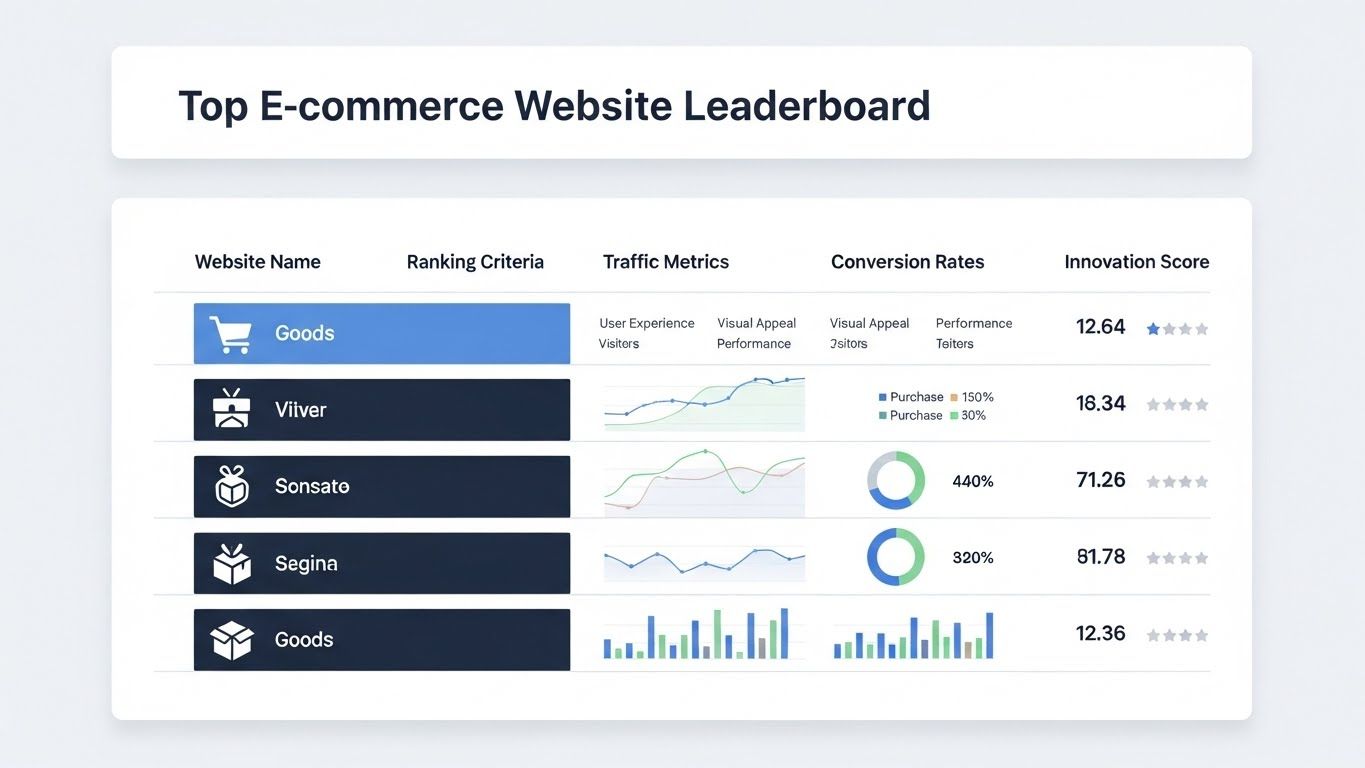
Here’s the rub: top ecommerce website designs aren’t ranked on aesthetics alone. They’re judged on: ✔️ Load time (under 2 seconds or GTFO) ✔️ Mobile conversion parity (desktop ≠ mobile ≠ tablet) ✔️ Accessibility (alt text, contrast, keyboard nav) ✔️ Emotional resonance (yes, really — dopamine counts) ✔️ Post-purchase flow (tracking, returns, “you might also love…”)
One study found that sites scoring >90 on Google’s Core Web Vitals saw **22% higher revenue per visitor**. So yeah — “best” isn’t subjective. It’s *measurable*. And your top ecommerce website designs better bring receipts.
Stars, Stripes, and Shopping Carts—Who’s Killing It in the USA?
America’s E-Commerce Hall of Fame (Unofficial, But Accurate)
“Which e-commerce is best in the USA?” Let’s cut through the noise. It’s not about who’s biggest — it’s about who’s *smartest*.
✅ ThredUp — re-commerce done right. Their top ecommerce website designs turn secondhand shopping into a treasure hunt: filters for “like new,” “vintage,” “designer,” and even “fits like a dream.” Plus, their “Goody Box” personalization? Chef’s kiss.
✅ Rhode (Hailey Bieber’s beauty line) — launched in 2022, now pulling $100M+ ARR. How? A homepage that’s 60% whitespace, 30% product close-ups, 10% CTAs that say “Glow Now.” No pop-ups. No urgency scams. Just *quiet confidence*.
✅ Chubbies — swim trunks + dad humor + flawless mobile UX. Their “Short of the Month” club? Genius. Their FAQ section? Written like a sitcom script. (“Yes, they’re *actually* short. No, your dog can’t wear them. Try anyway?”)
Fun stat: **68% of U.S. consumers** say they’ll pay *more* for a seamless shopping experience. Not faster shipping. Not free returns. *Experience*. So if your top ecommerce website designs feel like a DMV kiosk—time for a glow-up.
Profit or Pipe Dream? Let’s Talk Real Numbers
The Bottom Line in a World of Hype
“Is Ecom still profitable?” — asks the person who just bought a $42 “cloud-shaped” stress ball *and* a 12-pack of mushroom gummies named *Shiitake It Easy*.
Short answer: **yes**—but the golden age of “list it and they will come” is *over*. 2025 e-comm demands strategy, not just Shopify + Instagram ads.
Here’s the reality check: 📉 Average e-comm conversion rate? **2.5%** (up from 2.1% in 2020 — slow, but steady) 📉 Customer acquisition cost (CAC)? Up **60%** since 2020 📈 But—repeat customer LTV? Up **34%** 📈 And brands with strong post-purchase engagement? See **5x higher retention**
Translation: acquisition’s expensive. Retention’s *profitable*. And your top ecommerce website designs are the frontline of that retention war.
A well-designed homepage doesn’t just sell Day 1 — it *invites* Day 30. “Welcome back!” banners. “We saved your fave in stock” alerts. “Your last order + this new launch = 🔥” combos. That’s where margins live.
Pro move? Bake *profit levers* into design: - Bundles (increase AOV by 30% avg) - “Complete the look” (22% attach rate) - Post-checkout upsell (15% conversion — *after* they’ve paid!)
So yeah — e-comm’s profitable. But only if your top ecommerce website designs are working *harder* than your fulfillment team on Black Friday.

The Mobile Moment—Where 3.8 Billion People Decide in Under 3 Seconds
Thumb Scrolling Is the New Window Shopping
Let’s get real: if your top ecommerce website designs aren’t *mobile-first*, you’re not behind — you’re *invisible*. Over **67% of e-comm traffic** is mobile. And **40% of users** will abandon a site that’s not optimized for their screen.
But “mobile-friendly” ≠ “shrunk desktop.” Nah. Mobile needs: 🔹 Tap targets ≥ 48px (no one’s got surgeon fingers at 2 a.m.) 🔹 Sticky CTA bar (because scrolling back up = bounce city) 🔹 Simplified nav (hamburger menus? Only if they *work*) 🔹 Image lazy-loading (data plans ain’t free, y’all)
Check this: brands that implemented mobile-optimized cart flows saw **up to 35% higher mobile conversion**. One sneaker brand even added a “Swipe to peek” feature on product images — conversions jumped 18%. Because sometimes, all it takes is a flick of the wrist.
And for the love of bandwidth — ditch the interstitial pop-up that covers 90% of the screen. If I wanted to play Whac-A-Mole, I’d go to Chuck E. Cheese.
Typography That Talks—Not Just Sits There Looking Pretty
Because “Helvetica” Isn’t a Personality
Y’all ever land on a site and think, “Is this a legal doc or a hoodie store?” Yeah. Font choice isn’t “designer stuff.” It’s *psychology*. Sans-serif for tech? Clean, modern — cool. Serif for luxury? Elegant, timeless — *yes*. Handwritten script for a bakery? Warm, human — *if* it’s legible.
But here’s where most top ecommerce website designs shine: *hierarchy*. Not just font size — *rhythm*. - Hero headline: bold, condensed, high contrast - Subhead: lighter weight, generous line height - Body: 16px minimum, 1.5x line spacing (eyes get tired, fam) - CTAs: same font family, but *different weight + color* → creates visual “pull”
A/B test from a home goods brand: changing button text from “Add to Bag” (regular weight) to **“Add to Bag”** (bold + warm coral) lifted CTR by **12.7%**. All from *emphasis*.
Pro tip: avoid ALL CAPS for paragraphs. It’s not “loud” — it’s “hard to read.” And nobody’s got time for that.
Color—More Than Just Branding Flair
When Psychology Meets Palette
Red = urgency. Blue = trust. Green = growth. Orange = “wait, is this a CTA or a construction sign?” Color in top ecommerce website designs isn’t decoration — it’s *direction*.
Take Drunk Elephant: soft pinks and neutrals scream “clean beauty,” but their *CTAs* are vibrant coral — creating just enough pop to guide the eye without jarring the vibe.
Or Allbirds: earthy tones + a single bright green “Shop Now” button. It’s like a trail marker in a forest — subtle, but impossible to miss.
Data drop: sites using a *single dominant accent color* for all interactive elements saw **19% higher click consistency** than those using 3+ CTA colors. Why? Cognitive ease. Your brain goes: “Ah. That color = action.”
⚠️ Warning: don’t pick colors based on “what looks cool in Figma.” Test contrast ratios. WCAG AA minimum is 4.5:1 for body text. Tools like WebAIM Contrast Checker? Free. Your users’ eyes? Priceless.
And yeah — if your primary CTA blends into the background… we *see* you. And so does your bounce rate.
Product Pages—Where the Real Magic (and Money) Happens
Homepages Get the Date. Product Pages Seal the Deal.
Let’s be honest: most folks don’t buy from the homepage. They land, browse, click, *then* fall in love on the product page. So why do so many brands treat product pages like afterthoughts?
The top ecommerce website designs treat product pages like first dates — thoughtful, engaging, and *honest*.
✅ High-res zoom + 360° spin (because texture matters) ✅ Video demo (show it *in action* — not just on a mannequin) ✅ Size guide *with real people* (not just “S/M/L”) ✅ “Frequently bought together” (hello, +27% AOV) ✅ Real-time stock countdowns (*only* if accurate — fake scarcity = trust bankruptcy)
One outdoor gear brand added a “How It’s Made” tab with factory footage and material specs. Conversion jumped **21%** — because transparency builds trust faster than discounts.
Oh, and typos in product specs? Instant dealbreaker. (“Water resistent” → yeah, no.) Your top ecommerce website designs better spell-check *twice*.
Linking It All Together—The Homepage as Hub, Not Destination
You Don’t Win the Race at the Starting Line
A homepage isn’t where sales happen — it’s where *intent gets focused*. And the top ecommerce website designs treat it like a concierge: aware, helpful, and never pushy.
Great homepages don’t *force* — they *invite*. “New Arrivals” for the curious. “Bestsellers” for the confident. “Gift Finder” for the panicked. “Sustainability Report” for the values-driven. It’s about *pathways*, not pressure.
And those pathways? They need smart internal linking — not just for SEO, but for *user flow*.
Here are the three links we *always* bake in: 👉 Public Market — your digital HQ, where strategy meets execution 👉 Ecommerce — deep dives, frameworks, and real-world teardowns 👉 Ecommerce Web Design Solution For Your Business — when you’re ready to move from “meh” to “mind-blowing”
Because at the end of the day, your top ecommerce website designs shouldn’t just look good — they should *work* like a well-oiled machine. Quietly. Efficiently. And with just the right amount of soul.
Frequently Asked Questions
What is the most popular e-commerce website?
Amazon is the most popular e-commerce website globally, with over 300 million active users and dominance in nearly every product category. However, popularity doesn’t automatically make it a benchmark for top ecommerce website designs — especially for niche or brand-driven businesses where personality, storytelling, and user experience often outperform raw scale.
Which ecommerce website is best?
There’s no single “best”—it depends on your model, audience, and goals. Brands like Gymshark, Rhode, and ThredUp exemplify top ecommerce website designs by aligning UX, copy, and visuals with their community’s expectations. The true “best” are those that consistently deliver high Core Web Vitals scores, intuitive navigation, and post-purchase engagement—not just flashy homepage animations.
Which e-commerce is best in the USA?
In the U.S., standout examples of top ecommerce website designs include Chubbies (for humor + usability), Rhode (minimalist luxury), and ThredUp (re-commerce innovation). What they share: mobile-optimized flows, emotional CTAs, and data-informed personalization. Crucially, they prioritize *experience*—68% of American shoppers say they’ll pay more for seamless digital journeys.
Is Ecom still profitable?
Yes—but profitability now hinges on *retention*, not just acquisition. With CAC up 60% and average conversion at just 2.5%, the top ecommerce website designs focus on post-purchase loops: bundles, loyalty triggers, and hyper-relevant recommendations. Brands leveraging these see up to 5x higher repeat rates. So e-comm’s not dying—it’s maturing. And design is the new differentiator.
References
- https://www.digitalcommerce360.com/article/ecommerce-sales-statistics
- https://www.shopify.com/research/online-shopping-statistics
- https://web.dev/vitals
- https://www.nielsen.com/insights/2024/consumer-trust-in-personalization