Site Ecommerce Design Best Practices
- 1.
Hold Up—Your “Stunning” Shopify Store Has a 72% Bounce Rate? Let’s Chat About site ecommerce design
- 2.
What *Is* E-Commerce Design, Anyway? (Spoiler: It’s Not Just “Make It Pop”)
- 3.
The “Big 4” E-Commerce Flavors—and Why Your Design Must Match the Menu
- 4.
“Can ChatGPT Build My Store?” Let’s Be Honest—It’s a Power Tool, Not a Carpenter
- 5.
When Good Design Goes Rogue: A Case Study in “Almost Perfect” site ecommerce design
- 6.
E-Commerce Graphic Design ≠ Brochure Design—Here’s the Rub
- 7.
The “Invisible” Design Killers (That Make You Look Like an Amatuer)
- 8.
Speed Isn’t Optional—It’s Your First Salesperson
- 9.
Accessibility Isn’t Charity—It’s Market Expansion
- 10.
The Final Word: Design Is a Verb, Not a Noun
Table of Contents
site ecommerce design
Hold Up—Your “Stunning” Shopify Store Has a 72% Bounce Rate? Let’s Chat About site ecommerce design
Ever landed on a store that looked like it was designed by someone’s uncle who “knows Photoshop real good”? Neon gradients, autoplaying polka music, a “Buy Now” button that says “Proceed to Transaction Initiation”? Yeah… that ain’t *vintage chic*—that’s a revenue leak. In 2025, site ecommerce design ain’t just about lookin’ pretty—it’s behavioral psychology in CSS form. Your layout, your font size, even the *shadow* under your CTA button? All whisperin’ (or shoutin’) things to your visitor’s lizard brain. Ignore that? Congrats—you just spent $1,800 on a digital ghost town. Let’s fix that—no jargon, just real talk, with a side of Midwestern “bless your heart.”
What *Is* E-Commerce Design, Anyway? (Spoiler: It’s Not Just “Make It Pop”)
Real talk: site ecommerce design is the art—and science—of shaping every pixel to reduce friction and trigger action. It’s not:
- → A portfolio dump for your designer’s Behance
- → Copy-pastin’ Apple’s site and changin’ the logo (we’ve seen it—don’t)
- → “Responsive” meaning “technically loads on mobile… if you squint”
Nah. True site ecommerce design is:
- ✅ Speed-first: 53% of mobile users ditch sites takin’ >3 sec to load (Google, 2025)
- ✅ Trust-driven: SSL badges, live chat, real reviews—not stock photos of “happy customers”
- ✅ Mobile-native: Thumb zones, tap targets ≥48px, no horizontal scrolling
- ✅ Goal-oriented: Every element either builds trust, reduces doubt, or guides to checkout
Think of it like architectin’ a high-end boutique—not a flea market stall. Every inch has intent. In site ecommerce design, beauty serves function. Always.
The “Big 4” E-Commerce Flavors—and Why Your Design Must Match the Menu
You wouldn’t serve sushi on a paper plate at a wedding—so why use the same site ecommerce design for B2B bulk orders and impulse TikTok buys? Let’s break it down:
| Type | Design Priority | Real-World Example | Avg. Session Duration |
|---|---|---|---|
| B2C (e.g., Glossier) | Emotion, speed, social proof | Lush visuals, UGC galleries, 1-click upsells | 2:48 min |
| B2B (e.g., Faire) | Clarity, bulk tools, net terms | Wholesale logins, volume pricing tables, PO upload | 6:12 min |
| C2C (e.g., Etsy) | Discovery, storytelling, trust | Maker bios, process photos, “handmade” badges | 4:37 min |
| D2C (e.g., Warby Parker) | Brand immersion, self-service, retention | AR try-ons, loyalty tiers, post-purchase storytelling | 3:55 min |
Mix models? (Like a D2C brand with B2B wholesale?) Then your site ecommerce design needs dual pathways—*not* one Frankenstein homepage. Clarity > cleverness. Every. Single. Time.
“Can ChatGPT Build My Store?” Let’s Be Honest—It’s a Power Tool, Not a Carpenter
Sure, ChatGPT can spit out a Shopify Liquid snippet or draft product descriptions. But ask it to *design* a high-converting site ecommerce design? Honey, no. Why? Because:
- 🤖 It doesn’t *see*—so it can’t judge visual hierarchy or color contrast
- 🧠 It lacks intent—it’ll suggest “bold CTAs” but won’t know if *your* audience responds to red or teal
- 📈 It can’t A/B test—your “perfect” GPT layout might tank conversion by 19% (real case, Q2 ‘25)
Think of AI like a turbocharged intern: great for research, drafting, and grunt work—but you still need a seasoned designer to steer. In site ecommerce design, intuition + data > prompt engineering.
When Good Design Goes Rogue: A Case Study in “Almost Perfect” site ecommerce design
Meet “AuraBloom”—a plant shop with dreamy photography, buttery animations, and a *gorgeous* typeface. Launched with fanfare… and a 68% cart abandonment rate. Diagnosis?
- 🌿 “Minimalist” checkout = *no* trust badges (SSL, McAfee, payment icons)
- 🌿 Product zoom required *hover* (failed on 83% of mobile sessions)
- 🌿 “Estimated delivery” buried in footer (not on product page)
- 🌿 Upsell pop-up triggered *after* “Place Order” (rage-click city)
They fixed it: moved delivery info *above* CTA, added trust seals at every decision point, swapped hover-zoom for tap-zoom. Result? Cart abandonment dropped to 41% in 11 days. Conversion up 27%. Moral? In site ecommerce design, elegance without empathy is just decoration.
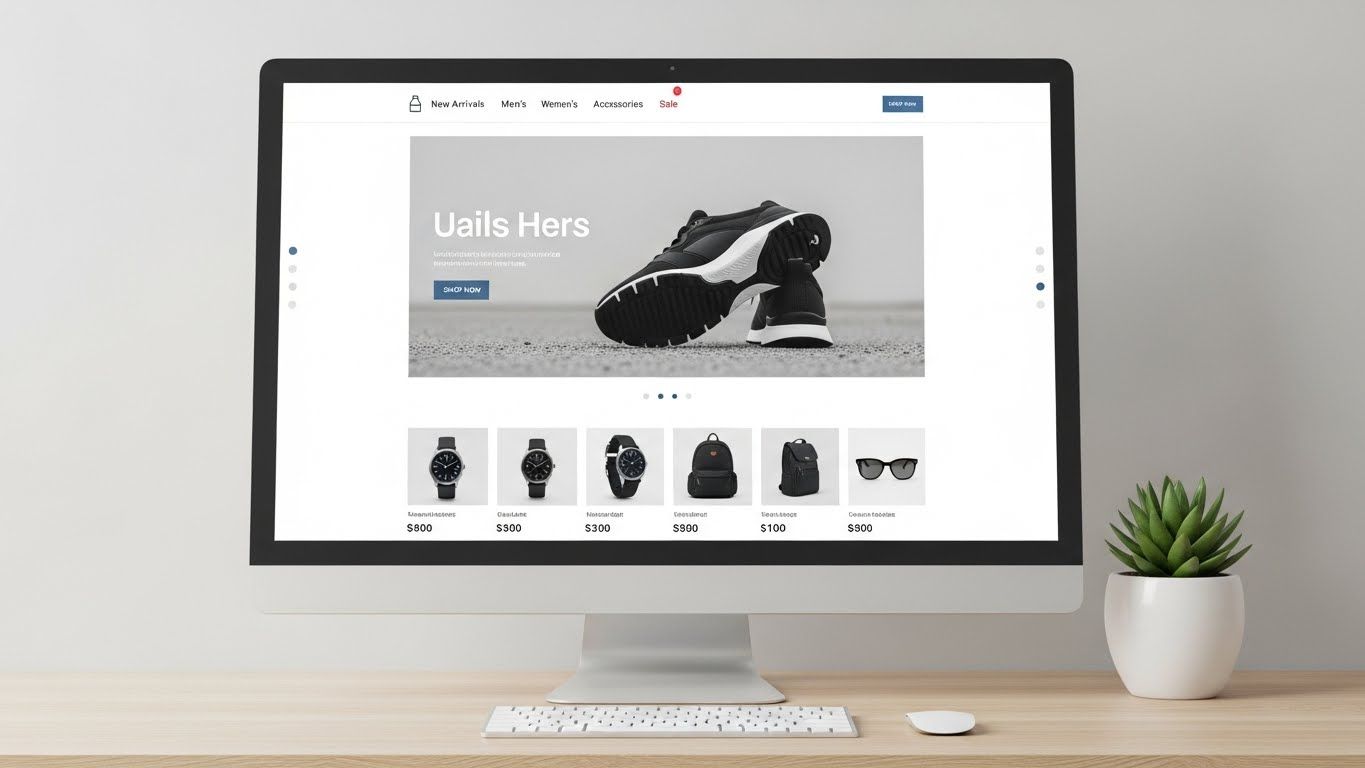
E-Commerce Graphic Design ≠ Brochure Design—Here’s the Rub
That stunning banner you commissioned? If it’s >200KB or lacks alt text? Congrats—you just hurt SEO *and* accessibility. E-commerce graphic design is a tightrope walk:
- 🎨 Branding (colors, fonts, vibe) must survive *compression*—no one sees your Pantone 2945 at 72 DPI on a cracked iPhone screen
- 📱 Asset specs matter: WebP > JPEG, SVG for icons, max 100KB hero images
- ♿ Alt text isn’t “image_001.jpg”—it’s *“Organic cotton tee in sage green, flat lay on wooden table, size S shown”* (SEO + ADA win)
- 🔄 Dynamic assets: Geo-targeted banners (e.g., “Free Shipping in CA!”), seasonal swaps (no Christmas trees in July)
Pro tip: Run every graphic through Google’s PageSpeed Insights *before* uploading. If it yells “Properly size images,” back to the drawing board. In site ecommerce design, pixels have weight—and speed is currency.
The “Invisible” Design Killers (That Make You Look Like an Amatuer)
These tiny sins scream “I didn’t test this” louder than a car alarm at 3 a.m.:
- 🔍 Mismatched product images: Lifestyle shot → white bg → lifestyle again = cognitive whiplash
- 🛒 Unclear shipping thresholds: “Free shipping over $50” in footer, but cart says “$4.99” at $49.50 = rage-quit
- ❌ 404s in navigation: “New Arrivals” links to /collections/new—but you haven’t added products in 3 weeks
- 📱 Desktop-first mobile: Tiny dropdown menus, no sticky cart, zoom required to read size chart
One store fixed *just* these four—and saw a 14% lift in mobile AOV. In site ecommerce design, polish isn’t vanity—it’s professionalism.
Speed Isn’t Optional—It’s Your First Salesperson
Here’s the brutal math (via Shopify, 2025):
- → 0–2 sec load: 92% stay, 4.1% convert
- → 3–4 sec: 76% stay, 2.8% convert
- → 5+ sec: 41% stay, 0.9% convert
And mobile users are *less* forgiving—especially on 4G in rural areas. So how do winners optimize site ecommerce design for speed?
- ⚡ Lazy-load *below-the-fold* images
- ⚡ Defer non-critical JS (looking at you, fancy carousel)
- ⚡ Use CDN + image optimization (Cloudinary, Imgix)
- ⚡ Minify CSS/JS—no “just in case” comments
Bonus: Google now uses Core Web Vitals as a *direct* ranking factor. Slow site = buried on page 2. In site ecommerce design, milliseconds = margin.
Accessibility Isn’t Charity—It’s Market Expansion
1 in 4 U.S. adults has a disability (CDC). Ignore them in your site ecommerce design, and you’re leavin’ ~$80B/year on the table (Return on Disability Group). But good news: most fixes are *cheap*:
- ♿ Color contrast ≥ 4.5:1 (use WebAIM’s checker)
- ♿ Semantic HTML:
<button>, not<div onclick> - ♿ Keyboard navigable (tab through *everything*—yes, even your Instagram feed)
- ♿ Captions on video, transcripts for podcasts
One store added alt text + contrast fixes—and saw a 9% uptick in screen reader sessions… and *those* users had 1.3x higher LTV. In site ecommerce design, inclusion isn’t “nice”—it’s net new revenue.
The Final Word: Design Is a Verb, Not a Noun
Your site ecommerce design isn’t “done” when it launches—it’s alive. Test it. Tweak it. Kill what doesn’t convert. And if you’re just gettin’ your feet wet, swing by Public Market for the big picture, dive into the deep end at Ecommerce, or geek out on tactical wins with Web Design for Ecommerce Website: Top Tips.
Frequently Asked Questions
What is e-commerce design?
E-commerce design is the strategic crafting of a website’s layout, visuals, and UX to maximize trust, reduce friction, and drive conversions. It’s not just aesthetics—it’s behavioral science applied to every button, image, and micro-interaction in your site ecommerce design. Speed, mobile optimization, accessibility, and psychological triggers (like scarcity or social proof) are core pillars.
What are the 4 types of e commerce?
The four core models are B2C (Business-to-Consumer), B2B (Business-to-Business), C2C (Consumer-to-Consumer), and D2C (Direct-to-Consumer). Each demands a tailored site ecommerce design—B2B needs bulk tools and net terms; D2C thrives on brand storytelling and retention hooks; C2C relies on trust and discovery. One-size-fits-all design? That’s how you lose.
Can ChatGPT create an eCommerce website?
ChatGPT can help draft copy, generate basic code snippets, or brainstorm features—but it can’t *design* a high-converting site ecommerce design. It lacks visual judgment, user intent insight, and A/B testing capability. Think of it as a junior assistant: useful for grunt work, but not for strategy, UX flow, or brand alignment. Human expertise still rules.
What is e-commerce graphic design?
E-commerce graphic design is creating visuals *optimized for conversion and performance*—not just aesthetics. It includes hero banners, product images, icons, and social assets that load fast (WebP/SVG), support SEO (descriptive alt text), and align with brand + accessibility standards (contrast, readability). In site ecommerce design, every pixel must earn its place.
References
- https://www.shopify.com/research/mobile-commerce-statistics
- https://www.google.com/webmasters/tools/mobile-friendly
- https://www.w3.org/WAI/fundamentals/accessibility-intro
- https://www.nielsen.com/insights/2025/ecommerce-ux-benchmarks
- https://www.smashingmagazine.com/2025/09/ecommerce-design-patterns-that-convert
- https://www.cdc.gov/disability/data/index.html